
Running GEMs Solo vs. With a Team
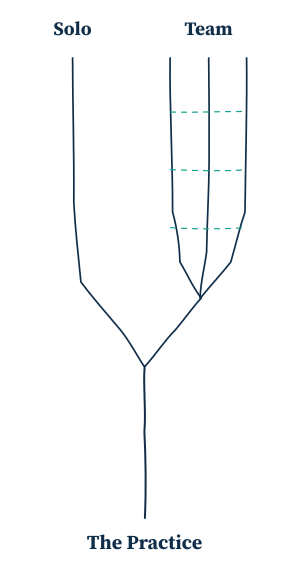
The individual practice is the foundation. Whether you're a solo consultant, a founder running everything yourself, or a VP running a functional team underneath a company goal, the core practice is the same. You record your strategic material. You distill it with AI. You check it against your plan. Every person in the GEMs system runs this practice for their own area.
The team practice adds a coordination layer on top. It doesn't replace the individual practice. It connects multiple individual practices together through shared goals, cascaded experiments, and a distributed planning rhythm.
This page explains what each version looks like and what changes between them. Solo is not a stripped-down version of the team practice. It's a complete practice for a different operating context.
What solo looks like
When you're running solo, you are the whole rhythm. You hold the annual plan. You run the quarterly checkpoint with yourself. You do the monthly focus. You keep the weekly rhythm alive. You are the operator and the strategist and the person doing the actual work, all in the same calendar and the same head.
Your strategic thinking happens in voice notes on walks. In conversations with Claude. In client calls you already record. In journal entries you write at 6am when the real issue becomes visible for the first time. Every week of your practice produces more strategic material than any planning system has ever been able to capture.
The weekly synthesis is the anchor of the solo practice. It's typically a 20-minute conversation with Claude on a Monday morning where you check the week's material against your plan. What experiments are you actually working on? Which measures should be moving? Has anything shifted that the plan needs to absorb?
Claude becomes the external voice you don't otherwise have. The pattern-spotter, the thinking partner who remembers the whole plan when you only remember the top three things. You aren't trying to replace a team. You're building a capability solo operators have never had access to before.
The personal and business seasons are the same system in a solo practice, because your capacity is the business's capacity. If your personal life is in Endure, your business plan needs to reflect that constraint, no matter how ambitious the goal feels.
What a leadership team looks like
The individual practice stays. Every leader on the team still runs their own GEMs cycle for their area. They still record, distill, and check. What gets added is the coordination layer that holds the team together.
Three things change when you move from solo to team.
First, the operator becomes a distinct role. In a solo practice, the operator is a discipline you hold inside yourself. On a team, someone takes the operator role explicitly. They make sure conversations get recorded, distillations happen, the tracker stays current, and the team stays accountable to the practice. The operator doesn't own the strategic outcomes. The leadership team owns those. The operator owns the rhythm.
Second, the cascade creates alignment structure. The company sets a goal. That goal stays whole. It doesn't get rewritten as it crosses team boundaries. What flows down are the experiments: the specific ideas each team will test in service of the shared goal. Each team runs their own GEMs cycle against the experiments they own, with their own measures and their own weekly rhythm.
Third, accountability shifts from self to team. In a solo practice, you're accountable to yourself and to Claude. On a team, accountability becomes explicit. You set expectations for when distillations happen, how quickly the tracker gets updated, and how the team responds when someone disengages from the practice. The operator catches drift across multiple conversations that no single person could hold in their head.
What stays the same
The three-step rhythm is the same at both scales. Record the conversation. Distill it with AI. Check it against the plan.
The FRESH diagnostic is the same. You name the season before you set the goal, whether you're one person or five.
The five planning horizons are the same. Annual, quarterly, monthly, weekly, daily. What changes is how many people share the rhythm and who runs each cadence. In a team, the CEO holds the annual. The operator runs the quarterly. Team leads run the monthly focus. The weekly check-ins happen in each team. The rhythm is the same. The distribution is what scales.
The hypothesis framing is the same. “We believe that doing X will produce Y.” Every experiment, whether it belongs to one person or to a team, starts with that statement.
The experiment outcomes are the same. Hypothesis held. Hypothesis did not hold. Inconclusive. Not success and failure. Learning.
How to know which tier fits you
If you are one person running your own planning practice, the Solo tier gives you the complete individual practice. The same framework, the same rhythm, the same AI-enabled capability, built for one person.
If you are a CEO, COO, or CPO running a leadership team of two to five people, the Leadership Team tier gives every person the individual practice plus the coordination layer: the team practice guide, the workshop kit for your first annual planning session, the team tracker templates, and the quarterly and monthly templates.
If you need GEMs across a larger organization, the Company tier starts with a conversation about your scale, your team structure, and your planning cadence.
For more on why AI matters at both scales, see Why AI Changes Planning → . For how the planning rhythm works across all five horizons, see The Planning Rhythm →.