
The Planning Rhythm
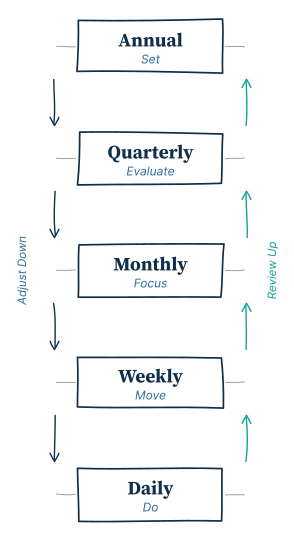
Most planning frameworks give you a moment. The annual offsite. The quarterly review. The monthly check-in. You do the planning work in that moment, set the goals, build the tracker, align the team. Then you go back to operating. The plan lives in a document. The work lives somewhere else. The two drift apart until the next planning moment brings them back together, briefly, before they drift apart again.
GEMs is designed to keep them connected. Not through willpower or discipline, but through a rhythm that runs continuously across five horizons.
The five horizons
Annual
The annual plan sets the direction. You name the goals, identify the strategic experiments, and define the lagging measures that will tell you whether you're achieving the outcomes that matter. This is where the full GEMs cycle begins. Before you set the goals, you run the FRESH diagnostic to make sure you're planning from the right season.
The annual plan isn't a detailed project plan. It's a set of directional bets. You're saying: this is the future we want to create, these are the experiments we believe will get us there, and these are the indicators that will tell us whether it's working. The detail comes later, at the quarterly and monthly level.
Quarterly
The quarterly checkpoint is the deepest review in the rhythm. You evaluate the experiment portfolio: which experiments are working, which aren't, and which need to be added or stopped. You score the measures. You update the tracker to reflect current reality and the plan for the next 90 days.
Quarterly is also where you ask the Review Up question for the first time: does the annual goal still make sense given what we've learned? If the answer is no, that triggers a conversation about whether to adjust the goal. Goals in GEMs have lifecycles. They can be Active, Achieved, or Stopped. The quarterly checkpoint is where those status changes happen.
Monthly
Monthly is where most of the real strategic thinking happens. You score the measures at a finer grain. You problem-solve the indicators that aren't moving. You adjust experiments based on what's actually working. Monthly is the interval at which you can see whether something is working. Weekly is too short to see movement on most measures. Quarterly is too long to catch drift before it compounds.
This is also where experiment outcomes get named. A hypothesis held: the experiment worked the way you expected. A hypothesis did not hold: it didn't produce the expected result. Or the result is inconclusive: you don't have enough signal yet. All three are useful data points that inform what you do next.
Weekly
The weekly check-in keeps the active work moving. You review active experiments, surface blockers, and make decisions that can't wait for the monthly review. These aren't status meetings. They're decision-making sessions. For a solo operator, this is often a 20-minute conversation with Claude on a Monday morning. For a leadership team, it's a focused session where each team reports on their experiments and raises the decisions that need to be made.
Daily
Every person in the system should be able to answer two questions at the start of any day: what experiment am I working on, and which measure should it move? That's the smallest unit of alignment. It's the connection between what you're doing today and the goal you set at the start of the year.
Daily isn't a meeting. It's a focused discipline. The tracker informs your priorities without being opened every morning.
Review Up, Adjust Down
The five horizons are not a waterfall. They're a feedback loop.
In most planning frameworks, direction flows in one direction: annual goals cascade into quarterly plans, quarterly plans cascade into monthly work, and teams execute. When reality changes, the framework has no mechanism to absorb it. Teams keep executing against a plan that no longer reflects what they're learning.
GEMs handles this through a principle called Review Up, Adjust Down. At every cadence, you ask two questions. Does the horizon above still make sense? And what do we need to change at our level?
If the answer to the first question is no, that triggers a conversation at the next level up. A monthly review can flag that the quarterly plan needs revisiting. A quarterly checkpoint can flag that an annual goal has been achieved, is no longer attainable, or that a new goal needs to be added. In urgent cases, any cadence can trigger a re-evaluation of any horizon above.
This is what makes GEMs a living system rather than a static plan. The rhythm isn't about rigidly executing against a fixed set of goals. It's about maintaining direction while staying responsive to what you're learning.
The rhythm works at every scale. One person running their own practice uses the same five horizons as a leadership team of five or a company of two hundred. What changes is how many people share the rhythm and how the cadences get distributed. For more on how the practice works at different scales, see Running GEMs Solo vs. With a Team →
For how the experiments that flow through this rhythm actually work, see The Experiment Layer →