
Why AI Changes Planning
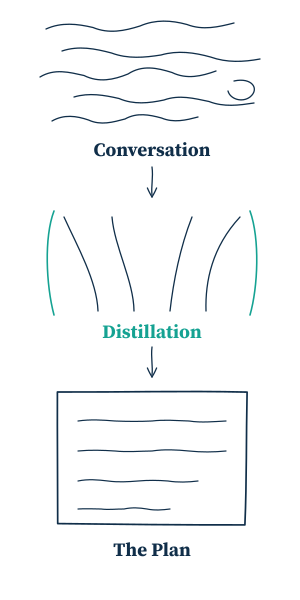
Your business generates more strategic signal every week than any planning system has ever been able to capture.
Client conversations where something shifted. Leadership meetings where a decision got made but never written down. A voice note on a walk where the real issue finally became visible. A contractor call where the pricing model stopped making sense. A strategy conversation with a co-founder that clarified the next six months in twenty minutes.
All of that is strategic material. Almost all of it is lost. Not because you don't care, but because no human being has the bandwidth to take every conversation, compare it against the active plan, and surface what matters. You remember the highlights. You lose the patterns. And the plan drifts from the work, the way it always does, because nobody is watching the gap.
The bandwidth problem
This is the core problem AI solves for planning. Not generating goals for you. Not writing your strategy. Instead, processing the volume of strategic signal your business already produces and comparing it against the plan you already have.
A leadership team talks for hours every week. A solo operator generates voice notes, journal entries, client debriefs, and reflection conversations constantly. The insights are in those conversations. The problem is that no single person can hold the full conversational history, compare every discussion against the active experiments and measures, and surface what changed. Your memory is selective. It remembers what felt important in the room. It doesn't remember the offhand comment in minute forty-seven that connected to the experiment you parked last quarter.
AI can hold the whole plan simultaneously. When you mention something in a Tuesday conversation that connects to a measure you defined in January, AI catches the connection. You wouldn't have. You were thinking about Tuesday's problem, not January's measure.
The drift problem
Without continuous comparison between the plan and the work, they drift apart. You don't notice it happening because drift is gradual. By the time you open the tracker at the quarterly review and the room goes quiet, the gap has been growing for weeks.
In a world where AI is collapsing the time between idea and execution, drift is accelerating. Code that took a sprint now takes an afternoon. Strategy decks that took a week now take an hour. Customer research that took a month now takes a day. Your team executes faster than they ever have. If your planning can't keep up with the speed of the work, the work wins. The plan becomes a historical document instead of a living guide.
What AI actually gives you
AI gives you four things that change how planning works in practice.
First, AI processes more than you can. It can analyze the full transcript of a leadership meeting, a client call, or a strategy conversation, and tell you which parts actually touched your plan. You stop relying on your memory of what felt important. You start working from a structured analysis of what was actually said.
Second, AI remembers the whole plan. You know the top three things you're working on. Your tracker has a goal, several experiments, several measures, parking lot items, hypothesis framing, and connections between experiments. AI holds all of them simultaneously and catches connections you would miss.
Third, AI challenges your thinking. When you bring a hypothesis into a conversation, AI can test it against the measures, the plan, and the signal in your recent conversations. If the data says the problem is different from what you assumed, AI surfaces the discrepancy. You can't do this for yourself. Your hypothesis is the lens you're looking through. You need something outside that lens to challenge it.
Fourth, AI closes the gap between thinking and tracker. Decisions get made in conversations and never make it to the tracker. Experiments get quietly deprioritized and nothing records it. AI does the distillation and produces a draft tracker update. You review it, confirm or adjust, and the tracker stays alive. The gap between what you decided and what is recorded shrinks from months to hours.
The three-step rhythm
The mechanism is simple. Record the conversation. Distill it with AI afterward. Run the distillation against the plan to see what changes.
That's it. Record, distill, check. You do this with every significant conversation your leadership team has, or every significant reflection you produce as a solo operator. Over time, it becomes the rhythm that keeps the plan connected to the work.
There's an honest limit here. AI can't yet sit in every conversation in real time and participate as a planning partner. The recording-and-distillation practice is the bridge to that future. It works now, it produces real value now, and it gets better as AI capabilities improve.
A capability, not a tool
This is the distinction that matters most. GEMs as a Claude skill is not another tool you add to the stack alongside your project manager and your spreadsheet. It's a capability. The practice of running your planning through AI builds a fundamentally different operating posture. You stop planning in moments and start planning continuously. You stop relying on memory and start relying on structured analysis. You stop hoping the plan and the work stay aligned and start watching them in near-real-time.
That's what AI-native planning actually means. Not AI generating your goals for you. AI as the place where your planning lives, so it can keep up with the work that's already happening there.