
GEMs and What You Already Use
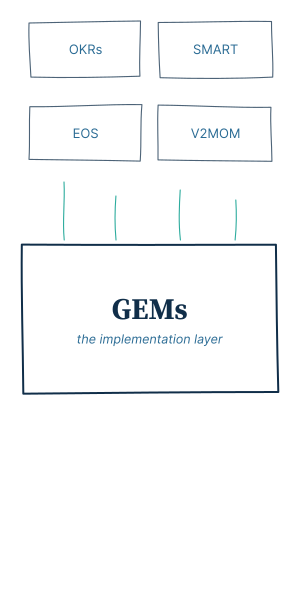
GEMs doesn't replace your current framework. It fills the gap they all share.
If you're reading this page, you've probably used at least one of the frameworks below. You've probably experienced the same frustration with all of them: the framework gives you a way to set the goal and a way to measure whether you hit it, but it doesn't give you the path between the two. That gap is where GEMs lives.
The crosswalks below show you how GEMs maps to each framework, what GEMs adds that the framework doesn't provide, and how to use them together. You don't have to abandon what you already have. You need to fill the gap it left behind.
GEMs and OKRs
OKRs give you Objectives (the goal) and Key Results (the measure). In GEMs terms, your Objectives become your Goals and your Key Results become your Measures. The mapping is nearly one-to-one.
What's missing from OKRs is the implementation layer. OKRs define where you want to go and how you'll know you got there. They don't define how you'll get there. Teams walk out of the OKR-setting session with Objectives and Key Results and then spend the next quarter inventing the path on the fly. Some of what they try works. Some doesn't. Nobody tracks which is which because OKRs never asked them to.
GEMs adds the Experiments. These are the specific, hypothesis-framed bets your team will test in pursuit of each Objective. “We believe that adding dedicated enterprise sales capacity will convert the pipeline we're building” sits between the Objective (“expand into enterprise”) and the Key Result (“sign three enterprise contracts this year”). It's the implementation plan that was always missing.
If your company already runs on OKRs, you keep the OKRs. You add the experiment layer underneath them. The OKR cadence stays. The GEMs planning rhythm adds the weekly and monthly structure that keeps the experiments alive between quarterly OKR reviews.
GEMs and SMART goals
SMART goals (Specific, Measurable, Achievable, Relevant, Time-bound) try to pack the goal and the measure into a single statement. “Increase enterprise revenue by 20% by December 31” is a SMART goal. It's specific, measurable, time-bound, and presumably achievable and relevant.
The problem is that combining the goal and the measure into one statement turns goal-setting into a measurement exercise. The team spends the offsite arguing about whether 20% is achievable and what counts as enterprise revenue, instead of thinking creatively about what they could try to move the number.
GEMs separates them on purpose. The Goal is the outcome you want: “We increase adoption of our product by enterprise customers.” That's directional, aspirational, and free of measurement constraints. The Measures come after the Experiments, not before. You dream about the goal before you worry about the measure.
To crosswalk GEMs to a SMART goal, you'd combine your Goal and your Measures into a single SMART statement: “Increase adoption of our product by enterprise customers by onboarding two new enterprise customers every quarter and retaining an NPS greater than 30 within 90 days of onboarding.” The Experiments don't appear in the SMART statement, but they live in the GEMs tracker as your implementation plan.
GEMs and EOS Rocks
EOS (the Entrepreneurial Operating System) uses Rocks as quarterly priorities. Rocks name what the company or team will focus on for the next 90 days. They're reviewed in weekly L10 meetings and scored at the quarterly review.
Rocks are good at naming what to focus on. Where they fall short is in framing the work as testable hypotheses. A Rock like “launch the new onboarding flow” is a task. It tells you what to build, but it doesn't tell you what you expect to happen when you build it or how you'll know if it worked beyond “it shipped.”
GEMs reframes each Rock as a hypothesis: “We believe that redesigning the onboarding flow will reduce time-to-value for new customers by 40%.” Now you have something to test. If you launch the new flow and time-to-value doesn't improve, you've learned something. The hypothesis didn't hold. That's data, not failure.
GEMs also adds the planning rhythm that keeps Rocks alive between quarterly reviews. EOS has L10 meetings for weekly accountability, but the connection between the weekly meeting and the quarterly Rock can feel thin. The GEMs monthly focus session fills that gap: it's where you score the measures, problem-solve the experiments that aren't working, and decide what to change before the quarterly review.
GEMs and V2MOM
V2MOM (Vision, Values, Methods, Obstacles, Measures) was developed at Salesforce. The mapping to GEMs is more complete than you might expect. Vision maps to your Goal. Methods map to your Experiments. Measures stay Measures. Values inform the alignment criteria that shape which experiments feel right for your organization.
Obstacles are where V2MOM maps most interestingly to GEMs. In V2MOM, you name the things standing in your way. In GEMs, two structures help you do that work more precisely. The FRESH diagnostic names the strategic season you're operating in, which is the broadest constraint on your planning. If your business is in Endure, that's the obstacle that shapes everything. And the LIFE filters, particularly Fit (“does this experiment belong in my current season?”) and Effort (“what's the true cost of running this?”), turn the obstacle awareness into prioritization decisions. Where V2MOM asks you to list what's in your way, GEMs gives you a diagnostic and a scoring system to plan around it.
The missing piece in V2MOM is the same as everywhere else: the continuous rhythm. V2MOM is typically written once per year and referenced periodically. GEMs adds the operating cadence that keeps the Methods (Experiments) alive and the Measures current.
The pattern across all four
Every framework gets the goal and the measure right. They all have a way to name where you want to go and how you'll know you got there. None of them give you the path between the two. GEMs is that path.
The experiment layer is what makes GEMs different. Not as a replacement for what you already use, but as the implementation system that was always missing underneath it. If your company runs on OKRs, EOS, V2MOM, or SMART goals, GEMs layers beneath them. You keep the framework your team already knows. You add the implementation structure that makes it work.
For a deeper look at the experiment layer itself, see The Experiment Layer →