
Next: The Planning Rhythm →
Prioritizing with LIFE
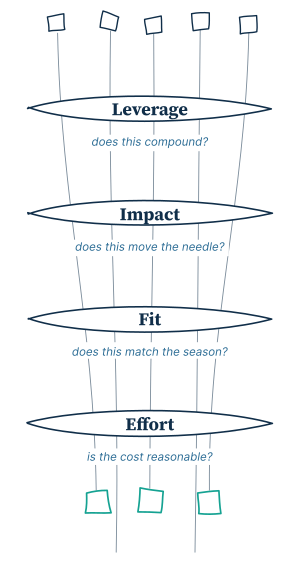
You've set the goal. You've brainstormed the experiments. Now you have a list of ideas, and some of them are better bets than others. The question is how to tell which ones.
Most planning frameworks skip this step entirely. They give you a way to set the goal and a way to measure whether you hit it, but they leave the prioritization of experiments to instinct, politics, or whoever talks the loudest in the room. GEMs gives you a structured way to evaluate your experiments before you commit resources to them.
The tool is called LIFE. It's four filters, each asking one question. You score each experiment on all four filters using a simple three-point scale: High (+), Medium (~), or Low (-). High is always the favorable direction. There's no math. No weighted averages. Just four honest questions and a conversation about the answers.
The four filters
Leverage
Does this create compounding value, or does it only work while I'm doing it?
Leverage is the difference between building an asset and performing a task. A leveraged experiment produces returns that continue or grow after the initial work is done. A low-leverage experiment only produces value while you're actively doing it.
High (+) means the experiment creates an asset, system, or capability that compounds over time. Medium (~) means it produces good results during the experiment but value doesn't compound significantly. Low (-) means it requires your ongoing presence and effort to produce any value at all.
Think of it this way: writing a playbook that your team uses for the next two years is high leverage. Personally handling every escalation is low leverage. Both might be necessary, but knowing which is which changes how you prioritize.
Impact
If this experiment works, how much will it move the measure?
Impact is about magnitude. A high-impact experiment, if successful, would produce a visible, measurable shift toward the goal. A low-impact experiment might produce a nice result but won't meaningfully change the trajectory.
High (+) means success would produce a visible shift in the goal, directly tied to the primary measure. Medium (~) means success would help, but it's one of several things that need to go right. Low (-) means it's nice to have, but even if it works perfectly, the effect on the measure would be marginal.
Impact is the filter that prevents busywork. A team can fill a quarter with medium-impact experiments that feel productive and still not move the needle. Impact asks: if this works, will we actually notice?
Fit
Does this experiment belong in my current season?
Fit connects directly to the FRESH diagnostic. An experiment might be high-impact and highly leveraged, but if it belongs in a Forge season and you're in Endure, it doesn't fit. Fit asks whether the experiment is appropriate for where you actually are, not where you wish you were.
High (+) means the experiment is a natural match for your current season. It aligns with your capacity, your strategic posture, and what your business and personal life can support right now. Medium (~) means it's reasonable but stretches your current season slightly. Low (-) means it belongs in a different season. Right idea, wrong time.
This is the filter that catches overreach. The CEO who is personally in Endure but keeps greenlighting Forge-level experiments for the business is ignoring Fit. Naming it makes the conversation possible.
For more on how the FRESH seasons shape your planning, see The Five Strategic Seasons →
Effort
What's the true cost of running this experiment?
Effort is the real cost. Not just calendar time, but cognitive load, emotional weight, complexity, dependencies, and context-switching. An experiment might only take two weeks to implement, but if it's draining, complex, and pulls focus from everything else, the true effort is high.
High (+) means the experiment is lightweight: quick to implement, energizing to work on, few dependencies, fits naturally into current workflows. Medium (~) means it requires dedicated time and coordination but is manageable within current capacity. Low (-) means it's a heavy lift: complex, draining, requires significant time or coordination, pulls focus from other work.
The scale is intentionally oriented so that High is always favorable. A High Effort rating means the experiment is easy to run. This keeps scoring consistent across all four filters, so you don't have to remember which direction is good for which filter.
How to use the filters
The process has four steps.
Step one: brainstorm freely. Get every experiment idea on the list without filtering. The LIFE filters come after the brainstorm, not during it. You don't want the scoring to kill ideas before they've been stated.
Step two: score each experiment. Rate each one on Leverage, Impact, Fit, and Effort using High (+), Medium (~), or Low (-).
Step three: sort by signal. Experiments with mostly plusses rise to the top. Experiments with mostly minuses go to the parking lot. Mixed signals, where one or two filters score high and the others don't, are where the real team discussion adds the most value. Those are the experiments worth debating.
Step four: check capacity. Before activating the top-scoring experiments, do the reality check. Can you actually run all of these simultaneously? If not, sequence them. The rest go to the parking lot, scored, ready, and waiting for capacity to open up. The parking lot is not a graveyard. It's a queue.
LIFE is a tool, not a tribunal
If a leader has strong conviction that an experiment matters despite a mediocre LIFE score, they can override the scoring. The purpose of the filters is not to make the decision for you. The purpose is to make the implicit conversation explicit: to surface the tradeoffs so teams make better decisions faster.
The most valuable moment in a LIFE scoring conversation is when two experiments score similarly and the team has to choose. That's when the real strategic thinking happens. The filters don't give you the answer. They give you the right argument.
How FRESH shapes which filters matter most
Your FRESH season naturally changes which LIFE filters carry the most weight. You don't need a formal weighting system. Your season provides the context. The filters provide the structure. When two experiments score similarly, your season tells you which filter breaks the tie.
In Forge, Impact and Leverage dominate. You need experiments that move fast and build momentum. You're placing bets, so you want bets that compound.
In Refine, Leverage and Effort dominate. You need experiments that reduce drag, not add it. The whole point of Refine is making what you have sustainable, so heavy-lift experiments work against the season.
In Endure, Fit and Effort dominate. You need experiments you can actually sustain in a hard season. Capacity is the constraint. Anything that scores low on Effort in Endure is probably a bad idea, no matter how high its Impact.
In Shift, Impact and Fit dominate. You need experiments that validate the new direction quickly. Fit matters here because you're testing whether something belongs in the future you're building, not the past you're leaving.
In Harvest, Fit and Leverage dominate. You need experiments that protect and extend what you've built. This is not the season for high-effort moonshots. It's the season for smart, compounding moves.
For more on the experiment layer that LIFE scores, see The Experiment Layer →. For how the five horizons keep experiments moving, see The Planning Rhythm →
The Planning Coach walks you through experiments and helps you frame them as hypotheses.