
Next: Prioritizing with LIFE →
The Five Strategic Seasons
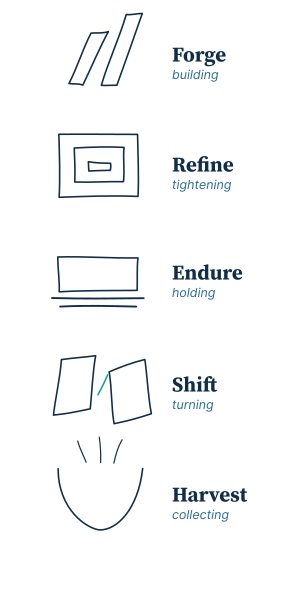
Before you set the goal, you need to know what season you're in.
Planning without knowing your season is like packing for a trip without checking the weather. You might get lucky. More often, you show up with the wrong gear and spend the whole trip compensating.
GEMs uses a diagnostic called FRESH to name five strategic seasons. Each one shapes the kind of goal you should set, the experiments that make sense, and how aggressively you should push. The seasons apply to your business and your personal life, and the interaction between the two is often where the real planning insight lives.
FRESH isn't a personality type or a lifecycle label that someone assigns to you. It's a working diagnosis you keep current. You revisit it quarterly, because seasons change.
The five seasons
Each season below includes what it looks like, what it means for your planning, and the biggest risk of getting it wrong.
Forge
You're building something that doesn't exist yet. Forward motion. A new company, a new product, a new market, a new chapter. The infrastructure may not be in place. You're designing the plane while flying it.
In business, this looks like launching a product, scaling a team, entering a new market, growing revenue, or adding capacity you've never had before.
What it means for planning: goals should be exploratory and ambitious. Experiments should be small and fast. You're looking for signal, not scale. Expect high experiment turnover. Many ideas won't work, and that's healthy in Forge. Leading indicators matter more than lagging ones because results haven't had time to materialize.
The biggest risk in Forge: trying to do everything at once because it all feels urgent.
Refine
What you have works, but it costs more effort than it should. You're successful but heavy. Systems, processes, and structures need to catch up to where you already are. The goal isn't to grow. It's to make what you've built sustainable.
In business, this looks like building SOPs, automating workflows, restructuring teams, reducing operational drag, eliminating low-value work, or paying down technical debt.
What it means for planning: goals focus on efficiency and sustainability, not expansion. Experiments are often internal and less visible. The work isn't glamorous, but it's foundational. This season often requires saying no to growth opportunities, temporarily and deliberately.
The biggest risk in Refine: skipping this season because it's not exciting, or starting it and abandoning it when a shiny opportunity appears.
Endure
You're in a hard season. Something has shifted and your primary job is to hold the line. This isn't about growing or refining. It's about preserving what matters most and letting everything else go.
In business, this looks like an economic downturn, lost clients, competitive disruption, leadership upheaval, cash flow crisis, or team attrition.
What it means for planning: goals are about maintaining core outcomes, not advancing. Experiments should be minimal, focused only on the highest-leverage actions that prevent decline. The parking lot gets very full, and that's the right call. One goal, maybe two, with ruthless prioritization. This is the season where goal limits matter most.
The biggest risk in Endure: staying in Endure mode after the crisis has passed. Endure is necessary and strategic, but it's not a place to live permanently.
Shift
The current direction isn't working, or it's no longer the right direction, and you know it. You're not in crisis (that's Endure). You've recognized that the goal itself needs to change. This season requires courage and intellectual honesty.
In business, this looks like pivoting the business model, entering a fundamentally new market, rethinking who you serve or how you deliver value, or a strategic reinvention.
What it means for planning: the goal itself is under review. This is the one season where moving the goalpost is appropriate. Early experiments are exploratory: research, discovery, prototyping, testing assumptions about the new direction. Measures are tentative. You're looking for validation signals, not recurring cadence metrics. Once the new direction is set, Shift often transitions into Forge.
The biggest risk in Shift: shifting too early before giving the current direction a real chance, or too late because of sunk cost, comfort, or pride.
Harvest
You've built something that works, and now you're reaping the value of it. The growth curve has flattened, by choice or by circumstance, and the focus is on sustaining and extracting maximum value from what you've created. Not every year needs to be a growth year.
In business, this looks like stable revenue, a mature market position, optimizing profitability, preparing for a sale or transition, or choosing to stay at a size that works.
What it means for planning: goals focus on sustaining success and maximizing returns, not chasing new ones. Experiments are selective. Measures focus on retention, profitability, and satisfaction rather than acquisition or expansion. This is a legitimate and often wise season. Recognizing you're in Harvest prevents you from chasing growth you don't actually want.
The biggest risk in Harvest: coasting into decline without realizing it. Harvest is a deliberate choice. Decline is what happens when you stop paying attention.
The two-part diagnostic
FRESH is most powerful when you name your season in two contexts. What season is your business in? And what season is your personal life in?
When there's a mismatch, the plan needs to reflect the constraint, not the ambition. If your business wants to Forge but your personal life is in Endure, the plan should account for that. This is where the honesty lives, and it's particularly important for solo operators and executives carrying heavy personal loads. Your capacity is real. Ignoring it doesn't make it bigger.
FRESH keeps the plan honest. When you name the season, you're doing what GEMs calls the challenge move: testing your hypothesis about where you are against what the evidence actually says. A CEO who insists the company is in Forge when the team is burning out is planning from aspiration, not reality. FRESH is the diagnostic that catches that before the plan does damage.
For how the seasons connect to the full planning rhythm, see The Planning Rhythm →